
Diesel emission claims 🚗

Table of Contents
You may have heard about diesel emissions claims — often linked to the term “Dieselgate”.
These are large group legal actions against major car manufacturers, alleging that certain diesel vehicles were fitted with software designed to cheat official emissions tests.
Around 1.6 million UK drivers have already signed up to these claims. For some people, it could eventually mean compensation — but it’s important to understand the risks, limits, and long timelines involved.
What are diesel emissions claims about?
The claims allege that some car manufacturers used illegal “defeat devices” in diesel vehicles.
These are alleged to be systems that:
detect when a car is being emissions-tested
reduce emissions during testing
but allow higher, more polluting emissions during real-world driving
Law firms argue this means affected vehicles:
produced more harmful nitrogen oxide (NOx) pollution than advertised
were mis-sold to consumers
may have been worth less than buyers paid
Manufacturers strongly deny these allegations. The courts will decide who is right.
Which vehicles could be affected?
In broad terms, claims relate to:
diesel cars and vans
first registered roughly between 2009 and 2020
across multiple major manufacturers
You may still be eligible even if:
you bought the vehicle second-hand
you leased it or used finance
you no longer own the vehicle
You generally cannot join if the vehicle was bought outside the UK.
Can you bring a claim yourself?
Realistically, no.
These cases involve:
complex technical evidence
emissions regulations
expert witnesses
and huge legal costs
For individuals, pursuing a solo case would be financially unrealistic, which is why these are brought as group legal actions.
If you pursue a claim at all, it will almost always be via a law firm running a group case (see below).
Claims progress: England & Wales
High Court trial underway (as of October 2025)
A major trial is currently taking place in the High Court of Justice, focusing on six “lead” manufacturers:
Citroën
Ford
Mercedes
Nissan
Peugeot
Renault
This trial is expected to:
run until late 2025
receive a judgment in summer 2026
If the claim succeeds, there would still need to be a separate follow-on trial to decide compensation — meaning payouts (if any) are likely years away, potentially 2027 or later.
If it fails, it could end many other diesel emissions claims at once.
Many other claims are currently on hold
Because of the scale of litigation, the courts selected the six manufacturers above as “lead defendants”.
This means:
other manufacturers’ cases are paused
they will likely be bound by the outcome of the lead case
This speeds things up overall — but also increases the risk of an all-or-nothing outcome.
Settled cases: VW Group (EA189 engines)
Some VW Group vehicles (Audi, Seat, Skoda, VW with EA189 engines) were involved in earlier cases that:
were settled out of court
resulted in £193 million being paid in England & Wales
However:
settlements set no legal precedent
individual payouts were confidential
and this doesn’t guarantee outcomes for other manufacturers
Is it too late to join in England & Wales?
For most manufacturers, yes.
The High Court set formal cut-off dates, and most passed by December 2024.
One limited exception:
Some firms are still accepting claims for certain Volvo vehicles, due to different alleged circumstances. This is being explored separately.
What about Scotland?
In Scotland, group legal actions are newer and:
some law firms are still accepting registrations
claims cover a range of manufacturers
However:
cases are less advanced
timelines are long
outcomes are uncertain
The firm you choose won’t usually affect whether the case wins — but it will affect how much you keep if compensation is awarded.
What about Northern Ireland?
At present:
we’re not aware of active diesel emissions group claims
no-win, no-fee arrangements are more restricted
This makes claims harder to pursue, though the situation could change.
How much compensation could you get?
This is the most important reality check.
While some law firms quote figures of:
£1,000s
or even up to £10,000
…the actual amount (if any) will depend on:
whether the claim succeeds
what financial loss the court believes you suffered
whether the case settles or goes to judgment
and legal fees
Even if claims succeed, payouts could be:
lower than advertised
reduced by legal costs
or paid years in the future
There are no guarantees.
Is signing up really “risk-free”?
Usually no upfront cost, but not risk-free.
Important points:
firms typically take 30%–50% of any payout
claims may be covered by “after the event” (ATE) insurance
in rare cases, costs could exceed insurance caps
You also usually have:
14 days to cancel after signing up, penalty-free
possible exit fees if you leave later (must be fair and clearly stated)
Only sign up if you’re comfortable committing long-term.
Recommended provider (optional – no win, no fee route)
If you’ve already checked you’re eligible and want a simple, online, no-win-no-fee option, we recommend Claim For My Car.
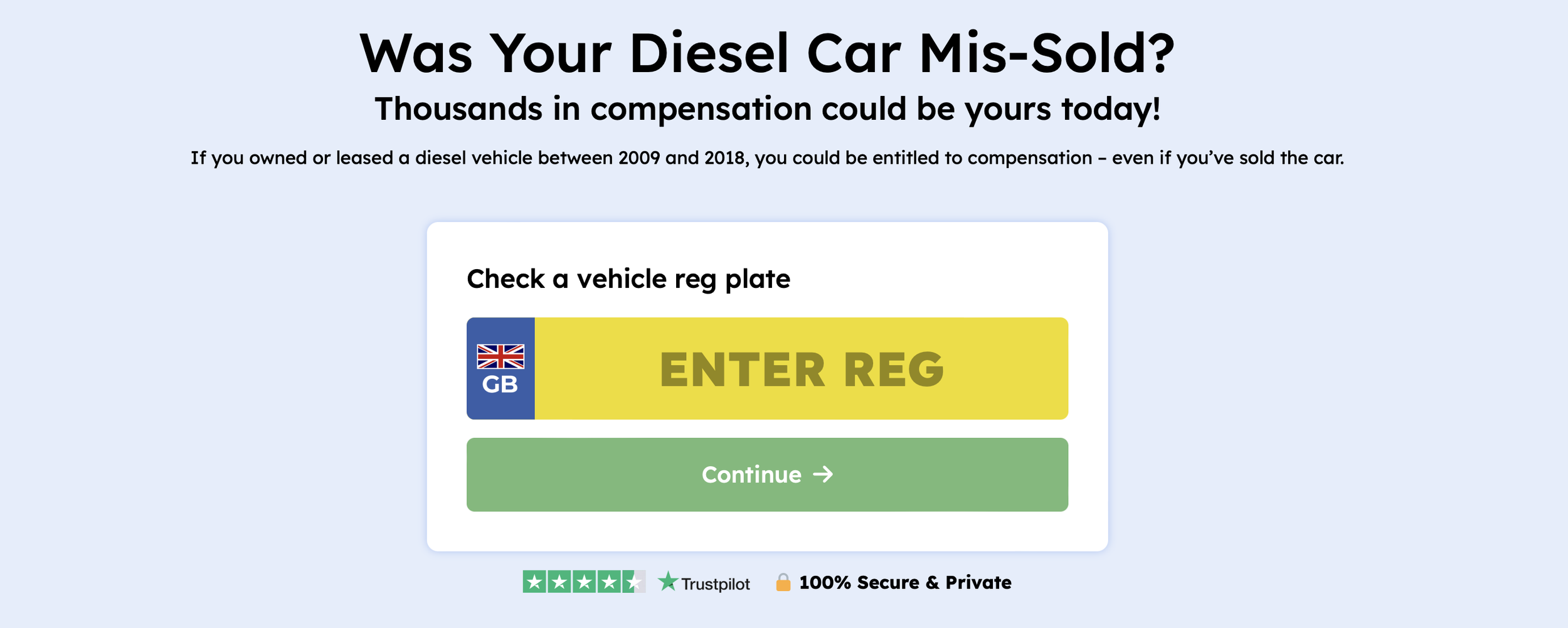
They allow you to:
🚗 Enter your reg plate and check eligibility in under 30 seconds
📄 Submit everything online (no paperwork posting back and forth)
⚖️ Join a wider group claim if eligible
💷 Pay nothing upfront — they only get paid if the claim succeeds
They currently cover brands including BMW, Mercedes, Ford, Jaguar, Land Rover, Range Rover, Renault and Nissan, and you can usually claim even if:
you’ve sold the vehicle
it was a company car
it was financed or leased
Why consider using a provider?
Diesel emissions claims are complex group legal actions.
You generally can’t realistically run one of these yourself, as they involve expert reports, coordinated court proceedings and significant legal costs.
A specialist firm:
Handles the legal process
Keeps you updated
Bundles your case into a larger group action
Absorbs most of the financial risk via no win, no fee agreements
The honest bit - going through a claim
Payouts are not guaranteed
Claims can take years
If successful, the firm will take a percentage of any compensation
If you withdraw after the cooling-off period, fees may apply depending on terms
This isn’t “free money” — it’s legal action that may or may not succeed.
But if you genuinely believe you were mis-sold a diesel vehicle and don’t want to navigate the legal process alone, using a specialist provider like Claim For My Car can be a practical way to take part.
Things to consider before joining a claim
Before signing anything, ask yourself:
Would I still pursue this if it takes 5+ years?
Am I comfortable with uncertain outcomes?
Do I believe I suffered a real financial loss?
Have I read and understood the fee structure?
If the answer to any of those is no, it may not be right for you.
What do manufacturers say?
All manufacturers involved deny wrongdoing and say:
their vehicles met emissions standards at the time
claims are without merit
and they will defend them robustly
The courts will ultimately decide.
Final thoughts
Diesel emissions claims are not easy money.
They are:
slow
complex
legally uncertain
and emotionally draining for some claimants
For some drivers, joining a claim may be worthwhile.
For others, the time, uncertainty, and potential returns won’t stack up.
The key is going in with eyes open.




























CLAIM NOW
Cashback is a website and platform which offers users cashback in exchange for completing tasks. To claim your £10…